Contents
Foreword and Rationale
Ion-Selective Electrodes (ISEs) have been widely used for more than thirty years, yet it is still remarkably difficult for the beginner to find an adequate explanation of the basic principles and applications of this technology. Manufacturers' pamphlets oversimplify; academic papers overwhelm the non-specialist with equations. This guide aims to fill that gap — giving sufficient information in accessible language to help the new analyst achieve the best possible results.
It also covers the latest developments in data acquisition and processing using meterless computer interfaces and sophisticated software.
The author thanks Heinz Kreuzberg for introducing him to ISEs and for masterminding the development of the computer interfaces described here, and Dr. Alexander Kapustin for training in ISE theory and practice.
Introduction to Ion-Selective Electrodes
Applications
Advantages
- Relatively inexpensive; extremely wide application and concentration range.
- Modern plastic-bodied models are robust and durable — field or laboratory use.
- In favourable conditions, very rapid measurements — dip in lakes, rivers, or effluents.
- Useful when only an order-of-magnitude concentration is required.
- Invaluable for continuous monitoring of concentration changes.
- Measure ion activity directly — important in biological/medical applications.
- With careful use, achieve ±2–3% accuracy for many ions.
- Measure both positive and negative ions.
- Unaffected by sample colour or turbidity.
- Wide temperature range — crystal membranes 0–80°C, plastic 0–50°C.
Basic Theory of ISE Measurements
The pH Electrode
The pH electrode is the simplest ISE. A glass membrane permits the passage of hydrogen ions. When immersed, H⁺ ions diffuse through until equilibrium is reached, building up charge proportional to the external concentration. This potential is measured relative to a stable reference electrode using a high-impedance millivolt meter.
pH is defined as the negative logarithm of the hydrogen ion concentration: pH 7 = 1×10⁻⁷ mol/L.
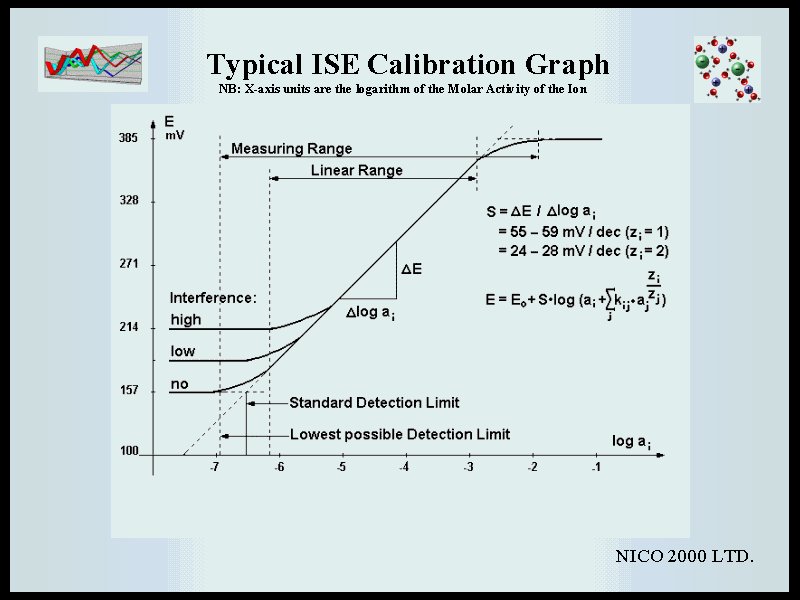
The slope of the calibration line (mV vs log activity) is the key diagnostic. For monovalent ions: approximately ±55 mV per decade of concentration. For divalent: ±26 mV.
Differences From pH
All ISEs operate on the same Nernst equation principle, but other ion-selective membranes are generally not 100% selective. Several factors can cause difficulties:
- Interference from other ions in solution
- Ionic strength effects at high concentrations
- Potential drift during measurement sequences
- Required use of Ionic Strength Adjustment Buffer (ISAB)
Recognising and managing these limitations allows ISEs to remain a highly cost-effective analytical tool.
Types of Ion-Selective Electrodes
General Discussion
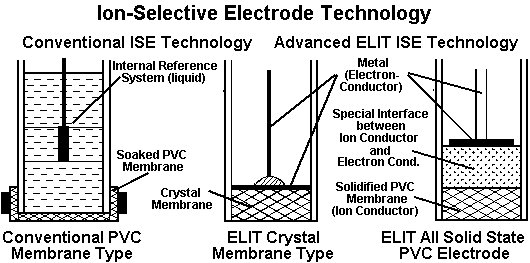
ISEs are cylindrical tubes, 5–15 mm diameter, 5–10 cm long, with an ion-selective membrane at one end. The internal connections may use liquid/gel electrolyte or an all-solid-state system. Membranes are currently available for:
Cations: NH₄⁺, Ba²⁺, Ca²⁺, Cd²⁺, Cu²⁺, Pb²⁺, Hg²⁺, K⁺, Na⁺, Ag⁺
Anions: Br⁻, Cl⁻, CN⁻, F⁻, I⁻, NO₃⁻, NO₂⁻, ClO₄⁻, S²⁻, SCN⁻
Crystal-Membrane Electrodes: Fluoride
The fluoride electrode uses a single crystal of Lanthanum Fluoride (LaF₃) doped with EuF₂. Crystal defects (holes) allow F⁻ ions to pass through selectively. Almost 100% selective — the only significant interference is OH⁻, eliminated by maintaining pH 4–8 using TISAB (Total Ionic Strength Adjustment Buffer).
Impregnated-PVC-Membrane Electrodes: Potassium
The potassium electrode uses a PVC membrane impregnated with valinomycin — a macrocyclic antibiotic with a ring structure matching the K⁺ ion diameter. Conducts K⁺ preferentially but not exclusively; Na⁺ and NH₄⁺ can cause errors at high concentrations.
Care and Maintenance
- Avoid damaging the membrane surface.
- For regular use: store open to air in a clean dry beaker.
- For long-term storage: protect with the cap provided.
- Crystal membranes: polish scratches with fine alumina or diamond paste.
- PVC membranes: soak in high-concentration solution to re-equilibrate after contamination.
Reference Electrodes
Single Junction Ag/AgCl Reference
The most common reference system. A silver wire coated with AgCl, immersed in 4M KCl saturated with AgCl, sealed with a porous ceramic frit. Provides a stable potential of +0.2046 V vs Standard Hydrogen Electrode at 25°C.
The K⁺ and Cl⁻ ions have nearly equal mobility (equi-transferrent), minimising the liquid junction potential.
Double Junction Reference Electrodes
A double junction electrode surrounds the inner Ag/AgCl cell with an outer chamber containing a different electrolyte. This prevents contamination of samples with K⁺ or Cl⁻ — critical when measuring these ions or when they interfere with the target ion.
The Nico2000 ELIT 003N uses Lithium Acetate — near equi-transferrent ions that do not interfere with most ISEs and minimise junction potential drift.
Liquid Junction Potentials
A potential develops at the porous frit junction between the filling solution and test solution. These are difficult to reproduce and can cause measurement errors. Minimised by using high-concentration equi-transferrent filling solutions and ISAB.
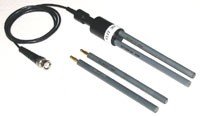
The ELIT Electrode Head System
Key advantages over conventional combination electrodes:
- One reference for several ISEs — more economical
- Replace a defective reference without sacrificing the ISE
- Low-noise cable stays on the reusable head
- ISE stored dry; reference electrode kept wet
- Greater electrode separation reduces interference
| Head Model | Sockets |
|---|---|
| ELIT 101 — Mono | 1 ISE only |
| ELIT 201 — Dual | 1 ISE + 1 RE |
| ELIT 301/401/701 | 2–6 ISE + 1 RE |
Problems with ISE Measurements
Ionic Interference and Selectivity Coefficients
ISEs are not ion-specific. All are sensitive to some interfering ions. The Selectivity Coefficient (SC) expresses this: SC = 0.1 means the electrode is 10× more sensitive to the primary ion than the interfering one. SC = 1 means equal sensitivity.
The SC is not constant — it depends on the concentrations of both ions, total ionic strength, and temperature. In many practical cases the ratio of interfering to primary ion can amplify the effect significantly.
Example: Chloride on the nitrate electrode has SC ≈ 0.003 — but in natural waters where Cl/NO₃ can be 50:1, this can cause a 15–20% over-reading of NO₃⁻.
Ionic Strength and Activity vs. Concentration
ISEs respond to ion activity, not total concentration. In dilute solutions these are essentially equal. At higher concentrations, inter-ionic interactions reduce the effective concentration at the membrane — causing an underestimate of the true value.
Solutions to the ionic strength problem:
- Add ISAB to both standards and samples to equalise ionic strength.
- Dilute samples to where the effect is insignificant.
- Make up standards in a similar matrix to the samples.
- Calculate the activity coefficient from known ionic composition.
- Use Standard Addition or Sample Addition methods.
Activity Coefficients — Error Reference
| Ion | Ionic Strength | Activity Coeff. | Error |
|---|---|---|---|
| Monovalent (K, Cl, NO₃) | 0.1 M | 0.771 | ~23% |
| Monovalent (K, Cl, NO₃) | 0.01 M | 0.901 | ~10% |
| Monovalent (K, Cl, NO₃) | 0.001 M | 0.965 | ~4% |
| Divalent (Ca, Cu) | 0.1 M | 0.439 | ~56% |
| Divalent (Ca, Cu) | 0.01 M | 0.682 | ~32% |
| Divalent (Ca, Cu) | 0.001 M | 0.870 | ~13% |
Ionic Strength Adjustment Buffers (ISAB)
ISAB is added to both standards and samples at the same ratio to bring all solutions to the same (high) ionic strength, making activity coefficients effectively equal across all measurements. Additionally, ISAB typically contains a pH buffer and may mask certain interfering ions.
Potential Drift
Drift sources include: temperature change, membrane equilibration, reference electrode liquid junction potential variation, and memory/hysteresis effects from previous samples. Allowance of 3 mV/8-hour working day is typical in specifications. Minimise by frequent calibration, thorough rinsing between samples, and working at stable temperature.
Calibration Theory and Practice
Theory
Calibration plots mV response vs log(activity/concentration). This should yield a straight line over the entire linear range. The slope is typically 54 mV/decade for monovalent and 26–27 mV/decade for divalent ions at room temperature. Departure from linearity near the detection limit defines the total measuring range.
The slope decreases with electrode age or contamination — a key diagnostic. When the slope drops significantly below the theoretical value, recondition or replace the electrode.
Practice
A single stock solution is diluted sequentially to give standards at 1000, 100, 10, 1, and 0.1 ppm (or in molarity decades). For the most precise slope determination:
- Measure in order of increasing concentration (low to high).
- For three or more standards, measure twice (once ascending, once descending) and average.
- Temperature of standards and samples must match within ±2°C.
- Two-point calibration is sufficient when working confidently in the linear range.
- For high precision: recalibrate fully before every batch of samples.
Measuring Procedures and Methods of Analysis
Measuring Procedure
Adding ISAB: Add in the same ratio (typically 1:10 ISAB:solution) to all standards and samples. ISAB also helps stabilise the reference electrode liquid junction potential and speeds equilibration in low-concentration samples.
Taking readings: Swirl the solution, allow 20–30 seconds to equilibrate, take the average of multiple readings. The ELIT analyser software averages 10 readings per second for maximum precision.
Between samples: Rinse the electrode tip thoroughly with deionised water, dab dry with a lint-free tissue. For highest precision: soak in deionised water 20–30 seconds before each measurement so every reading is approached from the same (low-concentration) direction.
Methods of Analysis
Direct Potentiometry
Simplest method — measure the unknown and read concentration from the calibration graph. Works for large batches across a wide range without recalibration. In favourable conditions (clear water, low ionic strength) electrodes can be dipped directly into rivers or ponds.
Standard Addition
Measure voltage in a large, accurately measured sample volume, then add a small volume of concentrated standard. Take a second reading. Calculate concentration from the voltage change. Eliminates most matrix effects — particularly useful for high ionic strength or complex matrices.
Sample Addition
The reverse — add a small volume of sample to a large volume of standard. Similar advantages as standard addition.
Potentiometric Titrations
Monitor titration endpoint using the ISE as an indicator electrode. Precision depends on volumetric accuracy rather than millivolt accuracy. Useful for extending the range of measurable ions (e.g. aluminium via fluoride electrode, titrating with NaF).
Accuracy and Precision
A 1 mV error in voltage measurement causes a 4% error in concentration for monovalent ions (slope 55 mV/decade) and 8% error for divalent ions (slope 26 mV/decade). Error is greater at low concentrations near the detection limit where the slope decreases.
Experimental Results — Ammonium
Using an ELIT ammonium electrode (PVC membrane) and ELIT 003N double junction reference, calibrated at 1 ppm and 10 ppm, a 5 ppm test solution was measured six times using the ELIT computer interface. Results:
- Mean: 5.11 ppm (2.2% over-read)
- Standard deviation: ±0.07 ppm (±1.4%)
- Range 4.98–5.22 ppm
Experimental Results — Chloride
Using a chloride crystal-membrane electrode, calibrated at 25 ppm and 250 ppm, eight measurements of a 100 ppm solution gave:
- Mean: 95.4 ± 0.6 ppm (±0.63% precision)
- Slight under-read likely due to calibration standards not closely bracketing the sample.
Best Practice for Maximum Accuracy
- Calibrate frequently — ideally immediately before each set of samples.
- Use standards that closely bracket the expected sample concentration range.
- Make a full two-point recalibration each time rather than relying on a stored slope.
- Control temperature — slope is temperature-dependent.
- Add the same ratio of ISAB to all standards and samples.
- Rinse and re-equilibrate electrodes thoroughly between measurements.
- Use a high-resolution measuring device (modern PC interfaces give sub-0.1 mV resolution).
Measuring Devices, Data Processing & Recent Developments
Evolution of Measuring Devices
Analogue meters: Simple, 1–2 mV resolution. Adequate for pH but insufficient for precise ISE work — a 5 mV change represents only 0.1 pH units, but for monovalent ion concentration it represents 4% error.
Digital meters: Higher resolution (0.1 mV). Enable direct concentration readout after calibration. Still require the operator to record calibration data and calculate results manually on self-calibrating models.
Self-calibrating ion meters: Determine the slope mathematically and display the concentration directly. Useful for routine work but less suitable for high-precision multi-component analysis.
Meterless Computer Interfaces
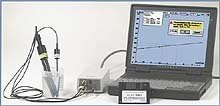
The ELIT Ion Analyser series represents the current state of the art: electrode signals are amplified and digitised by the interface unit, then transferred directly to any Windows PC. The software handles everything from calibration graph construction through to formatted reports.
- Virtually eliminates operator transcription errors
- Supports simultaneous multi-channel monitoring
- Integrating measurement (average of 10 readings/second) — maximises precision
- Exports to Excel for further processing
- Supports GLP documentation requirements

Multi-Component Analysis
The 4 and 8-channel analyser versions allow simultaneous monitoring of multiple ions, pH, ORP, and temperature in the same or different solutions. Ideal for batch monitoring where multiple reaction vessels need to be monitored simultaneously.
Software capabilities include:
- Calibrate each channel separately with up to 6 calibration points
- Simultaneous calibration of matched channels
- Any sensor can be allocated to any channel
- Each channel can have its own reference (different vessels) or share one
- Tabular display of all channels simultaneously
Further Information
Online resources at nico2000.net:
- Glossary of Terms and Calculations
- Internet Links & Bibliography (100+ research papers)
- Operating Instructions for ELIT ISEs
- Demonstration software for ELIT Ion Analysers
- MS PowerPoint presentation
Published research using ELIT products:
Over 60 peer-reviewed publications from universities and research institutions worldwide cite ELIT sensors. These cover environmental monitoring, food science, biomedical applications, pharmaceutical analysis, and more.
Author Biography
Chris C. Rundle BSc, PhD has been at the forefront of ISE instrumentation development at Nico2000 Ltd, London, since the early development of meterless computer interfaces for electrochemical sensors. This guide was first published in May 2000 and last updated in January 2011.
Original: CCR/HK/Nico2000 · Last update 31 Jan. 2011